
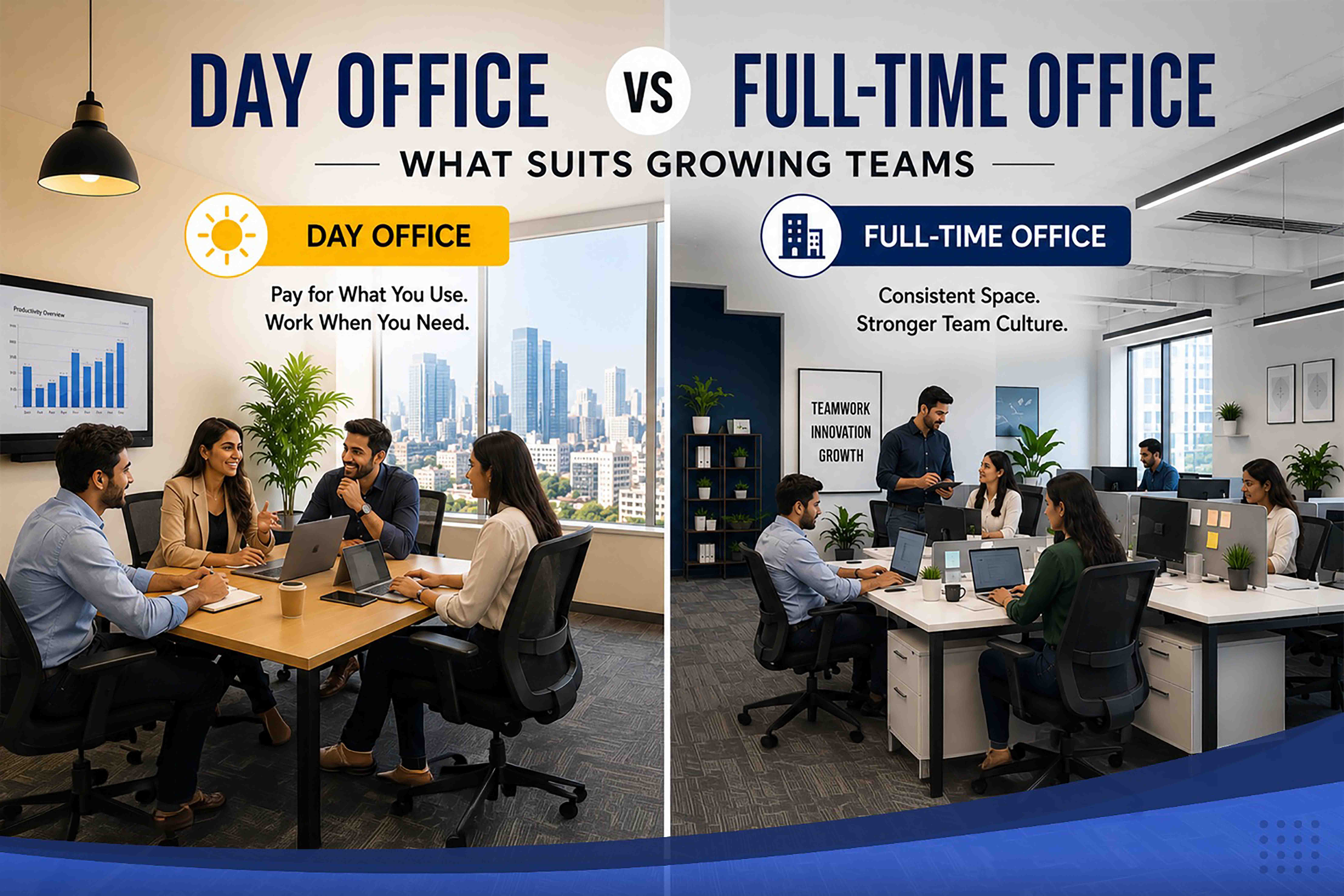
Day Office vs Full-Time Office: What Suits Growing Teams
A day office makes sense for teams that need space occasionally - client meetings, interviews, maybe just a quiet place away from home once or twice a week. A full-time office is good for teams that show up every day and need that consistency built in. It’s not just about how big the team is, but how often the space is used that makes the right call. For those who want to rent office space in Gurgaon, this difference is far more relevant than the number of employees.
Why This Question Comes Up So Often
Growing teams find themselves in a sort of awkward middle ground. Too big for a café meeting, not quite big enough (or stable enough) to justify a multi-year lease. That middle ground is where this comparison really starts to matter, and plenty of founders agonize over it far more than the decision really needs to.
What Is a Day Office, Exactly?
A day office gets booked as needed with a few hours here, a full day there; with no long-term commitment attached to it. Payment covers only the time actually used, which suits hybrid teams or businesses still working out how much space they genuinely need.
Useful for:
- Client meetings or interviews that call for a proper setting
- Remote teams meeting occasionally, not daily
- Startups not quite ready to commit to full-time office use
- Testing out a location before signing anything longer-term
And What Does a Full-Time Office Offer?
A full-time office, often set up as a managed office space, provides dedicated desks, steady access, and a fixed address every working day. Nothing to book, no availability to worry about - the space is simply there, day after day.
Useful for:
- Teams working in-office consistently, not sporadically
- Businesses that need a stable address and consistent branding
- Departments requiring secure storage or dedicated equipment
- Companies with headcount that doesn't shift much month to month
Comparing the Two in Practical Terms
- Cost structure — day offices charge per use; full-time setups come with a fixed monthly cost
- Flexibility — day offices win here; full-time offices trade flexibility for predictability
- Team culture — full-time spaces build stronger daily routines, while day offices suit scattered, hybrid patterns better
- Scalability — day offices scale naturally with usage; full-time setups typically need renegotiation to expand or shrink
When Flexible Office Space Makes More Sense
If monthly headcount keeps shifting, or the team hasn't fully settled into daily in-office work, flexible office space usually turns out to be the smarter financial move. Committing to a full-time lease before the team's actual rhythm is clear often backfires; sometimes within a matter of months, not years.
Plenty of startups fall into this trap early on. They lock in permanent space out of instinct rather than genuine need, then find themselves scrambling later when growth doesn't match the original assumptions.
When a Full-Time Office Actually Pays Off
Once daily attendance becomes consistent and headcount stabilizes, a full-time office tends to become the more sensible, cost-effective route. At that point, repeatedly booking day offices usually ends up costing more than a fixed monthly arrangement would.
So Which One Actually Fits a Growing Team?
There isn't a single right answer that applies across the board. Teams still finding their rhythm tend to benefit more from flexibility, while teams with predictable daily patterns benefit more from consistency. The common mistake is choosing based on where a business hopes to be a year from now, rather than where it stands today.
Summary
Choosing between a day office and a full-time office comes down to how consistently a growing team actually uses the space, not team size on its own. Altrade Business Centre works with businesses figuring out exactly this trade-off, helping them settle on office spaces for rent in Gurgaon that match how the team actually works, rather than a guess about where things might stand a year from now.

